Title:
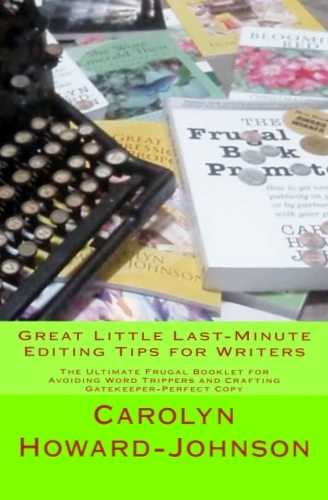
Great Little Last-Minute Editing Tips for Writers
Author: Carolyn Howard-Johnson
Publisher: HowToDoItFrugally Publishing
ISBN: 1450507654
Reviewed by
Karen Cioffi
What’s more important to a writer than words? Not much . .
. maybe how to put words together properly, using correct
grammar, weaving them together to create descriptive or
informative content . . . but, we still go back to the
foundation of every writer’s manuscript or article . . .
words.
Carolyn Howard Johnson’s latest book,
Great Little
Last-Minute Editing Tips for Writers,
is a little 55 page book (or e-book) that a writer can
refer back to over and over and over to find help with some
of the most common word trippers.
In the Before You Get Started section of this book,
Howard-Johnson explains, “Great Little Last-Minute Editing
Tips for Writers is full of words that are trouble causers.
They either sound alike or are spelled similarly. They are
not arcane words that you will seldom have an occasion to
use. They are not words the writer knows but still
mistypes.”
Words such as climactic and climatic used improperly or
misspelled can mean a rejection when submitting to the
“gatekeepers.” The addition or deletion of that little
second “c” makes a huge difference in the meaning of the
word.
Or, how about the words: all together / altogether;
demur / demure; one in the same / one and the same; and
peeked / peaked / piqued. These are just a few of the word
trippers added in the Great Little Last-Minute Editing
Tips for Writers.
Listed in an A – Z format, the words chosen for
this book are thoroughly explained with the aid of examples.
This all makes for an easy to understand and easy to read
guide. The author also provides two resource sections at the
end of the book: Reading: One Editing Book at a Time, and
Other Writers’ Aids.
I happen to be a fan of Carolyn Howard-Johnson’s Frugal
series and have the Frugal Editor as well as the
Frugal Book Promoter. They are a part of my writing and
marketing toolkit. The author has done it again with the
Great Little Last-Minute Editing Tips for Writers. She
has compiled this much needed booklet as an addendum to a
list in the appendix of her book,
The Frugal
Editor: Put Your Best Book Forward to Avoid Humiliation and
Ensure Success.
I learned a great deal from Great Little Last-Minute
Editing Tips for Writers and will be referring to it
often; I highly recommend it.
~ Reviewed by Karen Cioffi, author, writer-for-hire,
freelance write
Great
Little Last-Minute Editing Tips for Writers:
Subtitle: The Ultimate Frugal Booklet for Avoiding Word
Trippers and Crafting Gatekeeper-Perfect Copy
By Carolyn Howard-Johnson
HowToDoItFrugally Publishing, 2010
55 pages, e-book and paperback
Also available for Kindle
ISBN: 1450507654
Reviewed by Dawn Colclasure
Is there a difference between “childlike” and “childish”?
Actually, there is. That's just one of the things I learned
when reading Great Little Last Minute Editing Tips by
Carolyn Howard-Johnson, which is a companion volume to her
other book, The Frugal Editor: Put Your Best Book Forward to
Avoid Humiliation and Ensure Success.
Reading this book reminded me of the first book in my
Revisions series, which is scheduled for publication this
spring (and notice that it is “spring” and not “Spring”). In
the editing section of that book, I show the difference
between popularly confusing words, such as lay/lie,
this/that, who/whom and farther/further. In the first part
of this book, “Trip-You-Up Words,” Carolyn explores word
pairings (or even triplings) of words commonly confused with
each other.
I'm glad she included information on the difference
between "anxious" and "eager.” I trained myself to stop
using "anxious" in a positive way (such as, "I am anxious to
see you again") by remembering that the "anx-" prefix is
similar to "anxiety." Thus, "anxious" is similar to being
filled with anxiety. So would I be feeling anxiety at the
prospect of seeing a friend again? Not if it's a good
friend! So the correct word is "eager."
This made me laugh: "The sidekick baseball announcers are
big on commentary. My gawd! Those statistics and opinions!
They go on ad infinitum." (Page 20) One thing Carolyn is
known for is her wit and sense of humor. It was pleasant to
see this side of her shown in her book.
I wish she had included the difference between
compliment/complement. On the other hand, readers must
remember that this itty bitty book is only a “companion”
volume to her larger, in-depth book on editing. You’ll also
find more editing tips on her blog, “The Frugal, Smart and
Tuned-In Editor." If a word pairing is not covered here or
in her book, chances are good she has taken it on in her
blog.
She doesn't exactly explain why there is a difference
between "hope" and "hopefully," and why using "hopefully" in
the common way it is misused is incorrect. (I was surprised
to learn this, myself.) Again, however, check with her book,
or her blog.
I really appreciated reading this: "In English, we get to
make up a word now and then as long as we don't do it at the
threshold of a gatekeeper." (Page 28) So true! And very good
advice. One thing about being a logophile (lover of words)
is that we like to “take breaks” from our quest for proper
grammar and have fun with the object of our addic—er, I
mean, “affection.” One way we do this is to make up words,
and it’s such fun to make up words. Sometimes, I’ll write
out silly words just to pass the time, and the results can
sometimes pique my interest or cause me to chuckle. (And
Carolyn will be pleased to know that I have use “pique” as
her booklet instructs.)
I'm glad she pointed out the difference between “i.e.”
and “e.g.” as well as the importance of inserting commas on
either side of "i.e." and "e.g." She didn't, however, note
that the periods are likewise essential. I’ve seen many
people use them as “ie” and “eg.”
Some readers of this book, and many others like it, may
reach the conclusion that Carolyn must always have perfect
grammar and never make a mistake. Unfortunately, this is a
widespread opinion of such authors and writers. Even some
may believe such a thing of Mignon Fogarty ("Grammar Girl").
However, these writers are only human, and humans are prone
to make mistakes. Even grammarians make mistakes. Editors
make mistakes all the time. Carolyn reminds her readers of
this by sharing an embarrassing goof in using the wrong word
in the title of a poem she shared with her class, concluding
with: "This experience gives me a chance to remind you to be
forgiving of others when they error; your turn is sure to
come."
I was grateful to learn the difference between "podium"
and "lectern." I know I have misused "podium" a time or two.
Now, thanks to this "great little" book, I'll be sure to
remember which word is the correct one to use!
And now for the "curious word of the day." Cue the
fanfare! The curious word is: Swum. Yes, "swum" is indeed a
word, Carolyn notes. To be honest, I've always, always seen
either "swim," "swimmed" or "swam." But never "swum." It
made me wonder if there is a difference between "swum" and
"swam." ("Swam" is still a word, right?)
I love how she points out the popular mispronunciation of
words, some of which even I am guilty of. It is not "mischievious,"
but "mischievous." It is not "verbage" but "verbiage."
Likewise, she points out the popular way sayings are
repeated incorrectly. It is not "could care less" but
"couldn't care less." It is not "tie you over" but "tide you
over." In one of my manuscripts, a character is guilty of
often quoting popular phrases incorrectly, and we’ve all
gotten a chuckle or two when someone does this in a TV show
or movie. Still, it's nice to know the correct way to say
such a thing for what you really mean.
This “great little book” of editing tips gives readers a
down-to-earth and refreshing approach to better grammar and
usage. Grammarians bemoan the incorrect wording of the sign
“ten items or less” and chuckle over a sign advertising
“tattoo’s.” (Whose tattoo, exactly?) While we are imperfect
writers living in an imperfect world filled with grammar
mistakes and mispronunciations, it’s editing books like this
that helps us get one step closer to writing, and speaking,
clearly and succinctly.
~Reviewer Dawn Colclasure is an author
of Totally Scared: The Complete Book On Haunted Houses where
she shares everything you ever wanted to know about haunted
houses, and the ghosts who haunt them! She is a contributing writer
for SIGNews. Tweet with her at www.twitter.com/dawncolclasure. |