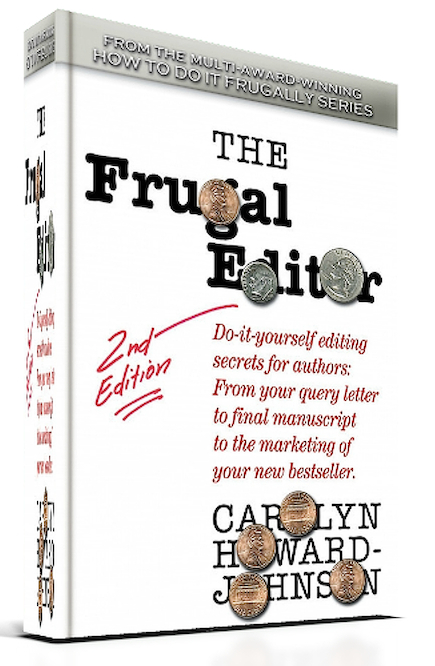
From the
Introduction of The Frugal Editor. I chose this so that readers
could see that, though this book is full of nitty-gritty essentials on
everything from choosing and editor to grammar horrors frequently seen
by agents and editors, it's light and entertaining reading.
(c)
Copyright 2007
Teachers
interested in reproducing portions of this book at no cost need only
contact me.
If he were only the
guy in the Lamisil ad with purple warts on his head I wouldn't worry
about him. You know, the one who causes toenails to yellow, the one you
try to eradicate at the risk of executing your liver. According to the
commercials, that gremlin is easy to avoid. Simply ask your
doctor for Lamisil.
If you imagine the
gremlin as the guy you had nightmares about when you were a kid, the one
who hid under your bed and cleverly disappeared when your parents peeked
under to search for him, well, he hasn't reappeared in decades. If he is
the chap who showed up in fairytales so we wouldn't get bored, we
authors might welcome him as inspiration for a short story. cleverly disappeared when your parents peeked
under to search for him, well, he hasn't reappeared in decades. If he is
the chap who showed up in fairytales so we wouldn't get bored, we
authors might welcome him as inspiration for a short story.
But no. He is the
dirty, lowdown creep who will make the passive tense
reappear in your manuscript after you've edited it twice,
maybe three times. And he has relatives. Enough of them to plague every
writer in existence. You won't be able to see them, won't know where
they come from, but you'll know they have been at work when your book
appears in print. Telltale signs will crop up in typos, grammar errors,
widows , and other ugly formatting problems, and so I worry about them a
lot. You should, too.
 I can't tell you how
to eliminate these gremlins. After all, there are homicide laws. But I
can tell you how to make their lives harder. You recognize they exist
and then purge any inclination you might have to let someone else bring
them to justice. For as real as these gremlins are--regardless of how
often we're told they're "only imaginary"--there is a myth that's passed
on to us as honest-to-goodness truth. That's the story authors believe
about editors and publishers. I can't tell you how
to eliminate these gremlins. After all, there are homicide laws. But I
can tell you how to make their lives harder. You recognize they exist
and then purge any inclination you might have to let someone else bring
them to justice. For as real as these gremlins are--regardless of how
often we're told they're "only imaginary"--there is a myth that's passed
on to us as honest-to-goodness truth. That's the story authors believe
about editors and publishers.
We writers believe
the stories because it's convenient to think that magical personages
hired by publishers make books come off the press in immaculate form.
Perfect. Pristine. That can happen, but I've come upon an occasional
typo in books that are published by revered names in our industry.
Worse, a few exist in my own books--more in some than in others. Some
showed up before I knew I had to take charge of my own books' destinies.
Some showed up after I knew that, but didn't know much about my part in
editing . So, you can trust my hard-won experience when I tell you it
behooves an author to do the very best she can--on her own--to eradicate
the gremlins' work. If these guys get one up on Random House and Farrar,
Straus & Giroux, other publishers and authors are easy touches.
So, how to do what
seems to elude the best and brightest of word warriors? That's what I'm
here for. I can't possibly cover all the possible tracks that gremlins
leave, but I can pass along antidotes for what I see most frequently in
the critique groups I facilitate and the classes I teach.
Some of this
information will seem pretty basic, but you need to know the gremlin's
secret. His motto is, "When authors and editors are looking for the big
stuff, I'll diddle with the puny mistakes they're not likely to see." Of
course, this guy is devious. He's not above going after more humiliating
errors like using apostrophes in plurals. He knows your weak moments,
your tired moments.
This book isn't only
about what to watch for. It's also about how to make the editing
process easier. You’ll find lots of information; some that you will
refer to time and again is in the sidebars. The sidebars are not listed
in the Contents. Mark them by creasing your page corners (you can tell I
believe in making a book your own) or use your index.
You'll also learn
both manual and electronic techniques for digging errors out of your
copy and keeping them out.
The most
important part of the process is getting over the idea that someone else
will do this for you or that it doesn't matter. It matters big. When you
submit queries to agents. When you submit proposals to publishers. When
your publisher submits a galley for you to examine and authorize. So
bear with me. Make the guidelines in this book part of your working
habits. You'll need several tricks up your own sleeve to keep all the
gremlins at bay.
The Frugal Editor is
complete with a helpful index and appendixes.
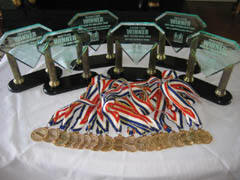 Carolyn
Howard-Johnson's promotion campaign for the Frugal Editor won New
Generation's Award for Marketing and the book was a finalist in the
how-to category. Carolyn
Howard-Johnson's promotion campaign for the Frugal Editor won New
Generation's Award for Marketing and the book was a finalist in the
how-to category.
|
|
|
Article |
|
Agents, Agents:
Questions About Agents!
Reprinted from Carolyn's
Sharing with Writers newsletter
Note:
The Frugal Editor includes a
chapter
summarizing pet peeves of the more than 100 well-known agents
Carolyn interviewed for that book.
Question
I
have a client who has pitched her book to several agents and publishers
at once. She has received at least a dozen requests to see the full
proposal; some asked for the manuscript. An unknown agent (not listed in
the AAR website or in the Writers Market) is interested in having her
sign an agreement for a 1-year exclusive to try to place the book with a
publisher.
How much time should we give the other agencies to respond? Should we
write them to let them know that we have an agent asking for an
exclusive? Knowing how difficult it is for an unknown first time writer
to get an agent, let alone a publishing contract, I don’t want to lose
the agent’s interest while waiting to see if someone better comes along.
Any advice?
Please keep me Anonymous to protect my client.
Answer from Carolyn
Yes, if you've done your homework and are pretty certain the agent is on
the up and up in spite of the lack of listing, write to the other
agents. Tell them you have another offer. Say something like "I hope to
hear from you by XXX, for I feel that we are the best fit. But you can
well guess that I am also eager to proceed with the publishing
process."
A
letter like that can only give your client credibility and might spur
the others to make a decision in her favor. Remember, good agents know
well how to get an auction going among publishers. They will not be
offended if you use a similar skill on them. But one must always come
from a position of authenticity.
BTW, one year is a long time. You might want to try to negotiate that:
Say, "I would feel more comfortable with a six month trial." You might
also ask if she has any specific contacts that she feels might be
interested and who they might be. That may be pushing it a bit but
considering this agent has no apparent credentials, a question like that
may be a good precaution. |
|
|
Tip from a Frugal
Editor Sidebar
Your Essential Desk References
-
The Chicago Manual of Style.
-
Associated Press Stylebook.
-
Elements of Style
by Strunk, White, and Angell. (Don't use one
from 1950!)
-
Your favorite thesaurus.
-
A good dictionary (Microsoft's Word language functions are not a substitute).
-
Special vocabulary dictionaries for dialect, jargon, scientific or tech terms.
-
Rhyming dictionary.
-
The Describer's Dictionary.
-
Need a guide to help
you style computer terms? Go to:
http://www.geocities.com/ikind_babel/babel/babel.html.
Those who are computer savvy will want to put important references for
their work into their computer's My Favorites and
add to it as they proceed with different tasks.
Find at least one tip on writing,
promotion or tech on every page of this Web site.
|
|
|
|
Buy Links for
Carolyn's Books
|
"Careers
that are not fed die as readily as
any living organism
given no sustenance."
~
Carolyn Howard-Johnson
Studio photography by
Uriah Carr
3 Dimensional Book Cover Images by iFOGO
Logo by
Lloyd King

|
Frugal
E-Book Tip |
|
Kindle E-Books
Aren't
Just for Kindle Anymore
Did you know that Amazon’s Kindle
e-books are a low-cost/no-cost way to access books
even if you don’t have a dedicated Kindle reader?
You can read Kindle's e-books on smartphones,
desktop computers and any e-device in between. You
can even store the books on the Amazon cloud.
~
Quote from
Diana Schneidman, author and
marketer |
To
subscribe to Carolyn's FREE online newsletter send an
e-mail.
Learn more about Carolyn's
newsletter and blog.
Read
past issues of Carolyn's
Newsletter.
|
Editing
Tip |
|
Here's a
tip I picked up from Stephen King's On Writing:
When you're writing dialogue and a character asks
a question, use a question mark at the end of the
question or "he asked" as a tag. Not both.
There are tons of tips like this in
The Frugal Editor.
Find at least one tip on writing, promotion, or
tech on every page of this Web site.
|
|
|
|
|
Subscribe to
Carolyn Howard-Johnson's Sharing with Writers Newsletter
and get a FREE copy of
Great Little Last-Minute Editing Tips for Writers

"I have been a professional writer 40 years, and am also a
tenured full professor of journalism. Carolyn's Sharing with
Writers newsletter is most useful for me--and for my
students. I emphasize to them that while research is 90% of
writing, and the actual writing is about 10%, there's another
100% out there called promotion. Carolyn shows numerous ways to
get the message to the mass media."
~Walter Brasch, author
and educator
"A decade of bettering writers' careers
with how-tos, tips, and publishing news."
|
|
Carolyn's Blogs |
|
The Frugal Retailer Blog
Carolyn shares nearly three decades of
retailing experience with
an emphasis on marketing.
Sharing with Writers
All things publishing with
an emphasis on book
promotion. Named to
Writer's Digest
101 Best Website list.
The New Book Review
Great way for readers, authors, reviewers and publicists to get more
mileage out of
a great review.
The Frugal Editor Blog
This is the Frugal, Smart
and Tuned-In Editor blog.
Covers editing, grammar, formatting and more.
Get the answers you need.
|
|
Time
to Kindle |
The Frugal Editor Is Available
as a Kindle Book
Click here to buy the big, powerful Kindle I love with free (Frugal!)
WiFi (Now in Paperwhite!):
|
|
|
Companion
Reading |
|
And here's
the Frugal Editor's companion, Ta Da!
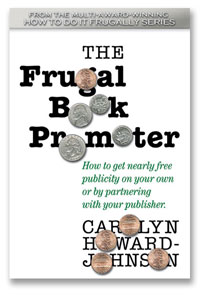
"After wading through
half a dozen cut and paste marketing books, I found it refreshing to
read Carolyn Howard-Johnson's down-to-earth approach to book promotion.
The Frugal Book Promoter is the real deal, easy to read and easy
to apply."
~Tom
Barnes,
author, actor and hurricane hunter |
|
While
You're Browsing... |
|
...find at least one promotion, writing,
or tech tip on every page on this site. Sometimes you'll find two or
three! Happy browsing and collecting!
|
|
Carolyn's Awards |
|
Awards for Carolyn's Books, Blogs and More The New Book Review
Named to
Master's in English.org Online Universities'
101 Essential Sites for Voracious
Readers
Writer's Digest 101 Best Websites
for Sharing with Writers blog.

Best Book Award for The Frugal Book Promoter (2004) and The Frugal Editor (2008)
and the Second Edition of The Frugal Book Promoter
(2011).
Reader Views Literary Award for The Frugal Editor

New Generation Award for Marketing and Finalist for The Frugal Editor
Book Publicists of Southern California's Irwin Award
Military Writers Award of Excellence for
Tracings, A Chapbook of Poetry.
A Retailer's Guide to Frugal In-Store Promotion wins author Military
Writers Society of America's Author of the Month award for March, 2010
Gold Medal
Award from Military Writers Society of America, 2010.
MWSA also gave a nod to
She Wore Emerald Then,
a chapbook of poetry honoring mothers.
The Frugal
Editor
Named #! on Top Ten
Editing Books list.
Finalist
New Generation Book Awards 2012,
The Frugal Book
Promoter; Finalist 2010
The Frugal Editor;
Winner 2010 Marketing Campaign for the Frugal Editor

The Oxford Award
recognizes
the
alumna who exemplifies the Delta Gamma precept of
service to her community and who, through the years,
devotes her talents to improve the quality of life
around her.
The Frugal
Book Promoter is runner-up in the how-to category for
the
Los Angeles Book Festival 2012
awards.

Winner Diamond Award
for Achievement in the Arts
Glendale
California's Arts and Culture Commission and the City of
Glendale Library,
2013
And more than a dozen other awards for Carolyn's novel, short story collection and poetry.
See the awards page on this site.
|
|